

In this guide 30
- Rainbow Mountain Peru Elevation and Trail Profile
- Managing High-Altitude Sickness at Rainbow Mountain Peru
- Vinicunca vs Palcoyo: Which Rainbow Mountain Should You Choose?
- How to Get to Rainbow Mountain from Cusco
- Adding the Red Valley Extension
- Best Time to Visit Rainbow Mountain Peru
- Practical Costs and Entry Fees
- Essential Packing List for Rainbow Mountain Peru
- Combining Rainbow Mountain Peru with Nearby Destinations
- Frequently Asked Questions
- Conclusion
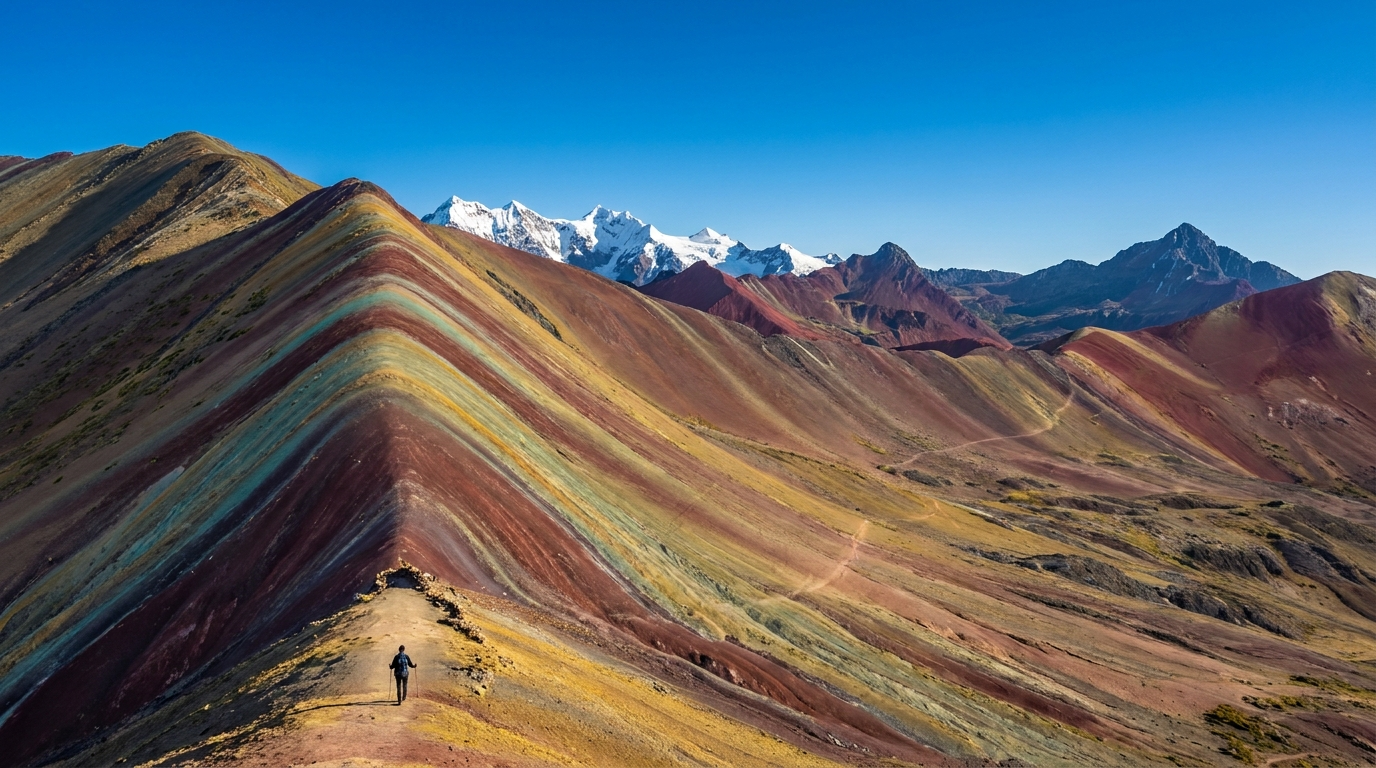
Rainbow Mountain Peru, known locally as Vinicunca or Montaña de Siete Colores, is a multicolored Andean ridge whose viewpoint reaches about 5,036 meters above sea level in Cusco Region, southern Peru. The hike to the main viewpoint is demanding, with thin air and steep sections that challenge even fit travelers, but the striped red, yellow, green and gray bands reward those who acclimatize properly. The drive from Cusco takes about three hours, and most visitors join organized day tours that depart before dawn and return by late afternoon.
The mountain’s vivid layers come from mineral-rich sedimentary rock exposed by erosion. Iron oxides create the reds and pinks, chlorite-rich rock and clays give the greens, sandstone with iron-sulphide minerals gives the mustard yellows, and quartz sandstone and marl give the whites. Vinicunca is not inside a national park; local communities manage access, collect entry fees and operate horse rentals at the trailhead.
Some links in this guide are affiliate links. If you book through one, Roamdusk may earn a commission at no extra cost to you. It never decides what we recommend.
Rainbow Mountain Peru Elevation and Trail Profile
The standard trailhead at Phulawasipata sits at roughly 4,600 to 4,700 meters, and the main viewpoint reaches about 5,036 meters, or 16,522 feet; the 5,200 meters often quoted is too high. The climb of about 400 meters is spread over roughly 3.5 to 4 kilometers each way, with the steepest part in the final exposed section. The ascent typically takes 1½ to 2 hours, and the return walk about 1 to 1½ hours, depending on fitness, weather and how well you have acclimatized.
The trail is uneven dirt and gravel, exposed to wind and cold, and steep enough in places that many visitors stop frequently to catch their breath. There is no technical scrambling, but the altitude makes every step harder than it would be at sea level. Horses can carry riders for most of the route, but the final 10 to 15 minutes to the summit must be walked because the ridge becomes too narrow and steep for animals.
Paid toilets at the trailhead car park and at a few points along the trail cost about S/2 to S/3, and vendors sell water, snacks and rain gear. Near the viewpoint you will find vendors selling snacks and hot drinks, but no toilets you can count on, so use the facilities on the way up. Carry small-denomination soles, toilet paper, hand sanitizer and enough water for the round trip.

Managing High-Altitude Sickness at Rainbow Mountain Peru
Acclimatization comes first
Spend at least two full nights in Cusco before attempting Vinicunca, and three nights is safer if you flew directly from low altitude. Do not rely on physical fitness alone: altitude sickness can affect experienced hikers, and pushing through symptoms above 5,000 meters can lead to serious illness. Rest on your first afternoon in Cusco, walk slowly, eat lightly and avoid alcohol for the first 24 to 48 hours.
Mild acute mountain sickness usually means a headache with nausea, loss of appetite, dizziness, fatigue or poor sleep. Some extra breathlessness on exertion is normal at altitude, but breathlessness far beyond what the effort explains can be an early sign of fluid on the lungs. If these worsen or do not improve with rest, stop ascending and consider turning back. Emergency symptoms require immediate descent and medical help: breathlessness at rest, confusion, loss of coordination, repeated vomiting, severe headache, persistent cough or blue lips.
Diamox, coca tea and emergency oxygen
Acetazolamide, sold as Diamox, is a prescription medicine that can help prevent altitude sickness. The usual prevention dose in the CDC’s travel guidance is 125 milligrams twice daily, starting the day before you go up and continuing for the first two days at altitude. Pharmacies in Peru sell it on prescription, so get it from your doctor before you travel, and mention kidney disease, electrolyte problems, pregnancy or any serious past reaction to a medicine. Common side effects include tingling in the fingers or toes, frequent urination and fizzy drinks tasting flat.
Coca tea and coca leaves are a traditional Andean remedy, but studies, including one of travelers in Cusco, have not shown that they prevent or treat altitude sickness. Sorojchi Pills, sold in Peruvian pharmacies, combine aspirin, salophen and caffeine; they may dull a headache but have no proven benefit against altitude sickness, so check the label and avoid doubling up on painkillers. Neither should replace proper acclimatization or prescribed medication. Many tours provide emergency oxygen, which can offer rapid but temporary relief; it is not a substitute for descent when symptoms are serious.

Vinicunca vs Palcoyo: Which Rainbow Mountain Should You Choose?
Palcoyo, also spelled Palccoyo, is a separate group of colored mountains in Checacupe district, about 3 to 3½ hours by road from Cusco, and is often marketed as an easier alternative to Vinicunca. Entry costs S/20 for foreign visitors. The two destinations are not the same place, and each suits different priorities. Vinicunca offers the iconic single striped ridge that appears in most Rainbow Mountain Peru photographs, while Palcoyo delivers several colored ridges, a stone forest and a shorter, gentler walk.
The table below compares the two options across the factors that matter most when deciding which to visit. Both sit at extreme altitude, so acclimatization is essential for either choice.
| Feature | Vinicunca | Palcoyo |
|---|---|---|
| Elevation | About 5,036 meters | About 4,900 meters |
| Trail distance | About 7 kilometers round trip | Roughly 3 to 4 kilometers round trip |
| Walking time | Usually 2 to 4 hours total | About 1 to 2 hours total |
| Terrain | Steeper, more strenuous ascent | Mostly gentle, relatively flat |
| Main scenery | The iconic single striped summit | Several colored ridges, broad panoramas |
| Bonus feature | Red Valley extension | Stone Forest, about 20 minutes extra |
| Crowds | About 1,500 visitors a day in peak season, with peaks near 2,000 | Usually under 100 a day |
Which one suits you?
Choose Vinicunca if you want the classic Rainbow Mountain Peru viewpoint, are prepared for a harder hike and can handle the crowds. The striped ridge is the image most people search for, and the Red Valley extension adds a striking rust-colored landscape that few other places match. Choose Palcoyo if you prefer a shorter, easier walk, want to avoid large groups or are traveling with families, older companions or anyone concerned about the physical demands of Vinicunca.
Palcoyo is not low-risk for altitude sickness despite its easier trail: its viewpoints still sit at about 4,900 meters. Walk slowly, stay hydrated and do not take young children or anyone with altitude-related medical concerns without professional advice. Neither option should be attempted on your first or second day in Cusco.

How to Get to Rainbow Mountain from Cusco
Organized day tours
The most practical option is a full-day tour from Cusco. Departures commonly begin around 3:00 to 5:00 a.m., with hotel pickup included, and the drive to the Phulawasipata trailhead takes about 3 hours each way. Tours typically include transport, breakfast and lunch, but entry fees, horse rides and Red Valley access may be extra. Group tours commonly cost about S/100 to S/300, depending on group size, transport quality, guide service and whether meals and entry are included.
Check what is covered before you book, and confirm the community entry fee shortly before departure because local administration and prices can change. Most tours return to Cusco around 5:00 to 6:00 p.m. Premium or private tours cost more but offer flexibility on departure time, stops and pace.
Independent travel via Cusipata or Pitumarca
Independent travelers can take a bus or colectivo from Cusco toward Cusipata, a journey of roughly 1½ to 2 hours, then take a shared taxi or colectivo to the Phulawasipata trailhead, about 1 to 1½ hours more and about S/25 to S/35. The alternative route runs via Checacupe and Pitumarca to the Kayrawiri trailhead in the Pampachiri area, but transport on that side is less predictable and the journey takes longer.
Shared transport is inexpensive but requires Spanish, flexibility and an early start. Driving from Cusco takes about 3 hours to the trailhead, depending on traffic, road conditions and the route selected. A high-clearance vehicle is preferable on the final roads, and road closures, community controls and changing trailheads can affect the journey, so do not rely on navigation alone.
Adding the Red Valley Extension
The Red Valley, or Valle Rojo, is a rust-colored landscape reached from the Vinicunca viewpoint area. The additional walk takes 30 to 60 minutes, and a separate cash fee of about S/20 to S/30 is charged. The valley offers a striking Mars-like contrast to the striped ridge, with far fewer visitors than the main viewpoint.
Many tours include the Red Valley as an optional extension, but confirm whether it is part of the itinerary and whether the entry fee is covered. The extra walking and altitude exposure add to the day’s demands, so judge whether you have the energy and acclimatization before committing. Ask your guide on the day whether the Red Valley path is open, because the communities sometimes close it.

Best Time to Visit Rainbow Mountain Peru
Dry season: May through October
The most reliable period for visiting Vinicunca is May through October, the Andean dry season. May, June, September and October often offer a useful balance between clearer weather and fewer visitors, while June through August can provide excellent visibility but brings very cold mornings and larger crowds. Even in the dry season, conditions can change rapidly, and the summit may have freezing wind or sleet while Cusco is sunny.
Pack warm layers, waterproof shells and gloves regardless of the forecast. Early arrival improves the chance of clear views before afternoon cloud rolls in, and most organized tours are timed to reach the viewpoint by mid-morning for that reason.
Wet season and shoulder months
December through March is the least dependable period. Rain, hail, cloud, mud and occasional snow can hide the colored layers or make the access road difficult. January and February are generally the months to avoid if your itinerary is inflexible. April and November are shoulder months: visits can succeed, but weather is less predictable, so build flexibility into your plans if traveling during those windows.
Check the weather forecast within a few days of departure, and verify with your tour operator that the road is open and conditions are safe. Tours occasionally cancel or reroute due to weather or community closures, so confirm arrangements shortly before you travel.
Practical Costs and Entry Fees
Community checkpoint and permits
Budget about S/30 for the foreign-visitor entry fee at the community checkpoint, paid in cash in Peruvian soles. Card payments are generally unavailable at the mountain checkpoint, so carry small denominations.
Some tours include the entry fee in the package price, while others list it as an additional cost. Check what is covered when you book, and bring extra soles for toilets, snacks and any optional extensions such as the Red Valley, which has its own cash fee.
Horse rentals: rates and ethical considerations
Horses are commonly offered at the Phulawasipata trailhead for the steep approach. Prices vary by season and bargaining: a one-way ride typically costs about S/70 to S/150, most often around S/100, and a round trip about S/160, paid in cash directly to the local handler.
Agree on the price, route and whether it covers the return before setting off. Horses cannot reach the summit: riders must dismount and walk the final 10 to 15 minutes because the ridge becomes too narrow and steep for animals. Choose a horse that appears alert, breathes normally at rest, has no visible sores or wounds and is not visibly underweight or distressed.
Do not ride if the handler appears to overload the horse, use an animal that is limping or struggling, or force it uphill. Ask the handler about the horse’s weight limit and whether animals are rotated and given rest; refuse the ride if the answer or conditions seem unsafe.
Horse use can provide direct income to nearby Andean families, but the altitude, uneven terrain, cold and repeated trips can create risks of exhaustion, falls, tendon strain and saddle injuries. The horse is best viewed as assistance for the lower or middle section, not a way to avoid the mountain’s hardest final climb.

Essential Packing List for Rainbow Mountain Peru
Clothing layers for extreme altitude
The summit is cold, windy and exposed, even in the dry season. Start with a merino wool or synthetic base layer, add a fleece or insulated mid-layer, and finish with a windproof and waterproof shell. Bring gloves, a warm hat that covers your ears, and UV-blocking sunglasses to protect against snow and altitude glare. Sunscreen is essential above 5,000 meters, where UV exposure is intense.
Wear sturdy hiking boots or trail shoes with good grip, because the trail is uneven and can be slippery in wet weather. Avoid new footwear; break in your boots before the trip to prevent blisters. Pack a small backpack with water, high-energy snacks, extra layers, rain gear and a headlamp in case of delays.
Other practical gear
Trekking poles reduce strain on your knees during the descent and help with balance on uneven ground. Carry enough Peruvian soles in small denominations for entry fees, toilets, snacks and horse rentals if you plan to use one. Bring toilet paper, hand sanitizer and a small plastic bag for rubbish, because there are no bins at the viewpoint. A camera or phone with a full battery is worth bringing, but cold drains batteries quickly, so keep devices warm inside your jacket when not in use.
Leave no litter, stay on marked paths, follow community instructions and do not remove rocks or plants. Weather can make the colored slopes look dull, so early arrival improves the chance of clear views and good photographs.
Combining Rainbow Mountain Peru with Nearby Destinations
Cusco and acclimatization
Allow at least two or three acclimatization days in Cusco for its historic center, San Pedro Market, Sacsayhuamán and nearby Inca sites. Cusco sits at about 3,400 meters, so those days are essential preparation for the higher altitude at Vinicunca. The city offers a wide range of accommodation, from budget hostels to upscale hotels, and is the natural base for organizing tours, confirming arrangements and adjusting to the altitude.
Walking Cusco’s cobbled streets, visiting markets and exploring nearby ruins are all useful ways to acclimatize while experiencing the region’s history and culture. Do not schedule Rainbow Mountain on your first or second day in the city.
Sacred Valley and Machu Picchu
Combine Pisac, Urubamba and Ollantaytambo with a Cusco itinerary. The Sacred Valley floor sits lower than Cusco, at roughly 2,800 to 3,000 meters, so it can be a gentler introduction to altitude if you arrive there first before moving up to the city. Chinchero, on the plateau above the valley, is higher than Cusco at about 3,760 meters. Ollantaytambo also provides access to trains for Machu Picchu day trips, although no train connects directly with Rainbow Mountain.
Ausangate and the Seven Lakes offer a longer high-altitude trek or day excursion in the same Vilcanota range, with glacial lakes and mountain scenery. It requires more preparation than Vinicunca and is suited to experienced trekkers with several days to spare. Palcoyo, as discussed earlier, is a separate colored-mountain area and a possible alternative for travelers seeking a shorter hike; some tours sell it simply as “Rainbow Mountain”, so check which mountain you are booking.

Frequently Asked Questions
How hard is the hike up Rainbow Mountain Peru?
The hike is demanding primarily because of the altitude, not the distance or technical difficulty. The trail gains about 400 meters over 3.5 to 4 kilometers, with the final section steep and exposed. Fit hikers who have acclimatized properly can usually complete the ascent in 1½ to 2 hours, but many visitors stop frequently to catch their breath. The return walk takes about 1 to 1½ hours. Horses are available for most of the route, but the final 10 to 15 minutes must be walked.
Can beginners do Rainbow Mountain?
Beginners can attempt Vinicunca if they acclimatize for at least two or three days in Cusco, walk at a slow and steady pace, and listen to their bodies. Physical fitness helps, but altitude sickness can affect anyone, regardless of experience. Do not push through worsening symptoms, and be prepared to turn back if you feel unwell. Joining an organized tour with a guide, emergency oxygen and a clear descent plan is the safest option for first-time high-altitude hikers.
What is the best month to visit Rainbow Mountain Peru?
The best months are May, June, September and October, when the dry season offers a balance between clear weather and manageable crowds. June through August provides excellent visibility but brings very cold mornings and the largest number of visitors. Avoid January and February if your schedule is inflexible, because rain, cloud and mud are most common during those months. April and November are shoulder months with less predictable weather, so build flexibility into your plans if traveling then.
Is one day enough for Rainbow Mountain?
One day is enough for the standard Vinicunca hike if you are staying in Cusco and have already acclimatized. Most organized tours depart before dawn and return by late afternoon or early evening, giving you time to rest afterward. If you plan to add the Red Valley extension or visit Palcoyo as well, confirm the itinerary and total walking time with your tour operator. Do not attempt Rainbow Mountain on the same day you arrive in Cusco or within 24 hours of flying from low altitude.
Do you need a guide to visit Vinicunca?
A guide is not legally required, but joining an organized tour is the most practical and safest option. Tours handle transport, meals, entry fees and emergency support, and guides know the route, weather patterns and altitude-sickness warning signs. Independent travelers can reach the trailhead by bus and colectivo, but the journey requires Spanish, flexibility and an early start, and you will still need to manage acclimatization, navigation and emergencies on your own.
Can you take horses all the way to the top of Rainbow Mountain?
No, horses stop before the final steep, narrow ridge, leaving about 10 to 15 minutes of walking to reach the viewpoint. Every rider must dismount and complete that section on foot. Horses are useful for the lower and middle sections of the trail, especially if you are struggling with the altitude, but they are not a way to avoid the hardest final climb.
Planning more of the Americas? See How to Get to Machu Picchu and Moraine Lake.
Before you go, check PromPerú’s Vinicunca visitor page for the latest details.
Conclusion
Rainbow Mountain Peru is a demanding but rewarding hike that requires proper acclimatization, realistic expectations and careful preparation. The striped ridge at about 5,036 meters is one of the most distinctive landscapes in the Andes, and the journey from Cusco offers a genuine high-altitude experience that few other day trips match. Spend at least two or three days in Cusco before attempting the hike, pack warm layers and waterproof gear, and choose a tour or route that suits your fitness and altitude tolerance.
Whether you visit Vinicunca for the iconic viewpoint or choose Palcoyo for a shorter, quieter alternative, the colored mountains deliver a landscape shaped by geology, altitude and erosion that is unlike anywhere else. Walk slowly, listen to your body, and turn back if symptoms worsen. The mountain will still be there, and arriving safely back in Cusco is always more important than reaching the summit.