

In this guide 34
- Best Time to Visit Wadi Rum and What the Weather Does
- How to Get to Wadi Rum from Aqaba, Petra and Amman
- Wadi Rum Desert Camps: Traditional Bedouin vs Luxury Bubble Domes
- Top Things to Do in Wadi Rum
- Wadi Rum Itineraries: One Night or Two
- Costs, Entrance Fee and the Jordan Pass
- Rules, Etiquette and What to Pack
- Combine Wadi Rum with Petra, Aqaba and Dana
- Frequently Asked Questions
- Conclusion
Wadi Rum is a 720 km² protected desert in southern Jordan, about 60 km north-east of Aqaba and close to the Saudi border. Locals call it the Valley of the Moon, a name that fits the broad sandy valleys, granite mountains and red sandstone cliffs that stretch across the landscape.
UNESCO inscribed the Wadi Rum Protected Area as a World Heritage Site in 2011 for its combined natural and cultural importance. Most visitors arrive at the Visitor Centre and Rum Village, then transfer to a Bedouin-operated 4×4 for a jeep tour and an overnight stay in a desert camp. The standard visit takes one night and two days, though two nights allow a slower pace and time to reach less-visited valleys.
This guide covers the best time to visit Wadi Rum, how to get there from Aqaba, Petra and Amman, the difference between traditional Bedouin camps and luxury bubble domes, what a jeep tour actually includes, and how much the whole experience costs. It also explains how the Jordan Pass treats the entrance fee, what to pack, and how to combine Wadi Rum with Petra, Aqaba and Dana.
Some links in this guide are affiliate links. If you book through one, Roamdusk may earn a commission at no extra cost to you. It never decides what we recommend.
Best Time to Visit Wadi Rum and What the Weather Does
The most comfortable months for Wadi Rum are March through May and September through November. Days are warm enough for jeep tours, camel rides and short hikes, while nights remain cold but manageable with the blankets camps provide. October and November are especially suitable because the daytime heat has dropped but the sky stays clear for stargazing.
June, July and August bring intense heat, with temperatures commonly above 35°C and sometimes reaching 40°C or higher. Activities are possible if you schedule them early in the morning and late in the afternoon, but midday excursions are uncomfortable and dehydration becomes a real risk. December through February offer pleasant daytime conditions, often around 15 to 20°C, but nights can approach freezing in exposed camps. If you visit in winter, confirm that your camp provides enough blankets or a heater, because luxury bubble domes usually include climate control while traditional Bedouin tents rely on layers and campfires.
When the Milky Way Is Visible
Wadi Rum is rated around Bortle 2 for light pollution, which makes it one of the darkest night-sky locations in the Middle East. The Milky Way is visible to the naked eye on clear nights from roughly March through October, with the bright galactic core best placed in the summer months. Plan your visit around the new moon or a thin crescent if astrophotography or stargazing is a priority, because a full moon washes out faint stars and reduces the visibility of the Milky Way band.
Allow your eyes at least 20 to 30 minutes to adapt to darkness, use only red light from a headlamp, and keep phone screens dimmed. Ask your camp when the generator and outdoor lights go off, because even a small lamp ruins dark adaptation and creates enough light pollution to spoil long-exposure photographs.
How to Get to Wadi Rum from Aqaba, Petra and Amman
A side road leaves the Desert Highway near Rashidiya and runs east to the Visitor Centre and Rum Village. Most visitors arrive by taxi, private transfer or a prearranged pickup organized by their camp. There are no scheduled passenger trains to Wadi Rum.
From Aqaba
Aqaba city is roughly 60 to 70 km from Rum Village, and the drive normally takes about one hour. A one-way taxi commonly costs 25 to 40 Jordanian dinars, depending on whether you are picked up in the city centre, at South Beach, at the border crossing or at King Hussein International Airport. A local minibus also runs from Aqaba to the Visitor Centre for about 3 JOD, usually once a day around midday and not on Fridays, but it leaves only when it is full, so ask at the Aqaba bus station the day before for the expected departure time.
Many camps include a pickup from Aqaba in their package price or offer it as an add-on for about 20 to 30 JOD. Ask whether the quoted price covers the transfer, the entrance fee, meals and the jeep tour, because some camps advertise a low nightly rate but charge separately for every component.
From Petra
The journey from Petra to Wadi Rum is a little over 100 km and usually takes 1.5 to 2 hours by car or private transfer. A taxi costs roughly 50 to 70 JOD depending on negotiation and whether you book through your Petra hotel or arrange it directly. Combining Petra with Wadi Rum is Jordan’s most common southern itinerary, and many visitors spend one full day at Petra, drive to Wadi Rum in the late afternoon, then stay one or two nights in the desert before continuing to Aqaba or returning north.
From Amman and Queen Alia International Airport
Amman is about four hours from Wadi Rum by road. Queen Alia International Airport lies south of the city, so the drive from the airport is a little shorter, usually around 3.5 to 4 hours. The simplest public-transport route is a JETT bus from Amman to Aqaba, which takes roughly four hours and costs around 11 JOD, followed by a taxi or a prearranged camp transfer for the final hour.
Private transfers from Amman or the airport cost approximately 100 to 150 JOD for a car, which is practical if you are travelling as a group or prefer to avoid the bus connection. Confirm the pickup time, the drop-off point at the Visitor Centre or your camp, and whether the driver will wait if your flight is delayed.
Wadi Rum Desert Camps: Traditional Bedouin vs Luxury Bubble Domes
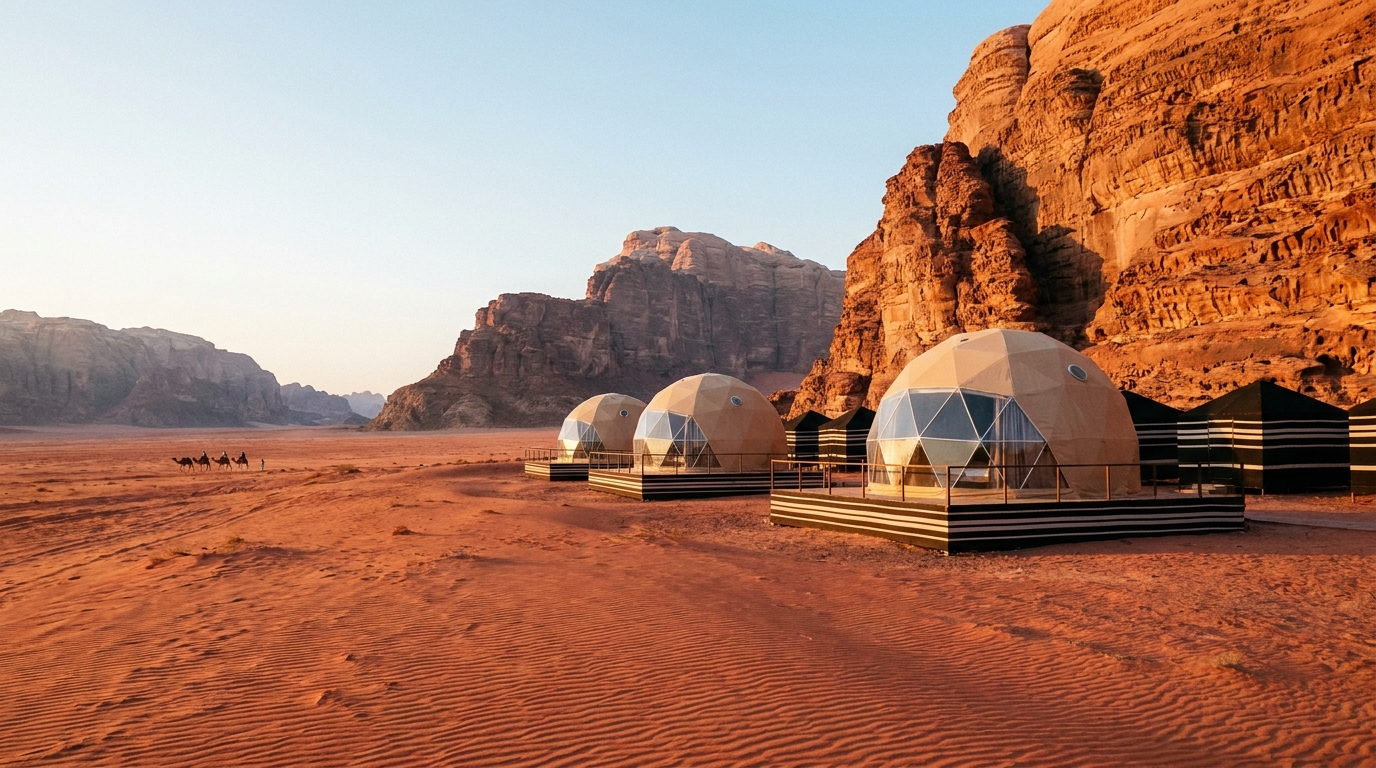
Accommodation in Wadi Rum falls into two broad categories: traditional Bedouin camps with goat-hair or canvas tents and shared facilities, and luxury camps with private bathrooms, climate control and often transparent bubble domes that let you watch the stars from bed. Both types usually include dinner and breakfast, and most camps offer a jeep tour as part of the package. The main differences lie in comfort, privacy, amenities and price.

What Traditional Bedouin Camps Offer
Traditional camps use goat-hair or canvas tents, a bed with blankets and rugs, and communal bathroom blocks with toilets, sinks and showers. Hot water is often solar-heated or tank-based, so showers may be warmer during the day and less reliable late at night or early in the morning. Electricity is usually limited to solar or generator power, with possible nighttime cutoffs, and mobile coverage is weak or absent. Most camps have no Wi-Fi, or offer it only in a communal area near the reception tent.
The atmosphere is more communal and culturally immersive, with Bedouin tea, traditional music, storytelling around the campfire and meals cooked in a zarb, an underground oven. Dinner is typically served in a shared majlis tent, and the experience centres on the desert setting rather than hotel-style amenities. Basic camps with shared bathrooms start at roughly 20 to 25 JOD per person per night, while mid-range camps with private bathrooms usually cost about 40 to 60 JOD per person, generally including dinner and breakfast.

What Luxury Bubble Domes and Serviced Camps Provide
Luxury bubble camps feature transparent or panoramic domes with a clear roof, so you can lie in bed and watch the stars without leaving your room. These camps usually include a proper bed with premium linens, a private en-suite bathroom with a shower, and hot water that is more consistently available, though supply may still be limited by the camp’s solar or tank systems. Electricity is typically available for lighting, charging, heating or air conditioning, and upscale camps may advertise 24-hour power, though it is worth confirming whether that power is solar, generator or a battery system.
Some luxury camps offer Wi-Fi, but it may only reach the reception or dining area, so ask before you book if you need it in the dome. Heating and air conditioning are frequently included in premium domes, which makes winter and summer visits more comfortable. The atmosphere is more private and romantic, closest to a desert hotel experience, and meals are often served in a smaller dining area rather than a communal tent. Prices commonly start around 100 JOD per dome per night and often reach 150 JOD or more, depending on the camp and inclusions.
| Feature | Traditional Bedouin Camp | Luxury Bubble Dome Camp |
|---|---|---|
| Accommodation | Goat-hair or canvas tent, bed, blankets, rugs | Transparent dome, premium bed, private terrace in some |
| Bathroom | Shared block, basic facilities | Private en-suite with shower |
| Hot water | Solar or tank, less reliable at night | More consistent, though still limited by camp systems |
| Electricity | Limited solar or generator, possible nighttime cutoff | Usually 24 hours, lighting, charging, climate control |
| Wi-Fi | Often unavailable or limited to communal area | Available at some camps, ask where it reaches |
| Atmosphere | Communal, campfire, traditional music, cultural immersion | Private, romantic, star-focused, hotel-style |
| Price per night | About 20 to 60 JOD per person, usually with dinner and breakfast | From about 100 JOD per dome, often 150 JOD or more |
Top Things to Do in Wadi Rum
A standard visit combines a 4×4 jeep tour with an overnight camp stay. Jeep tours generally last four to six hours and visit several of the protected area’s most accessible landmarks, including natural rock arches, narrow canyons with ancient petroglyphs, red sand dunes and springs associated with T. E. Lawrence. Camel rides are usually shorter, often one to two hours around sunset or sunrise, and longer camel treks are possible with advance arrangement. Most camps also offer guided walks, stargazing sessions, traditional music and meals cooked in a zarb.
What a Jeep Tour Covers
A shared or small-group 4×4 tour costs about 20 to 40 JOD per person for several hours, while a private 4×4 runs approximately 50 to 100 JOD or more depending on duration and group size. If you prefer to arrange it before you arrive, you can book a full-day tour online. The tour normally visits a circuit of landmarks chosen by the driver, and you can request specific stops if you book a private vehicle.
At the Visitor Centre, visitors leave ordinary cars and transfer to a Bedouin-operated 4×4, because standard vehicles cannot handle the sand and rock tracks inside the protected area. Camps generally provide a meeting point and may arrange transport from Rum Village, so confirm whether the advertised price includes the transfer, entrance fee and meals.
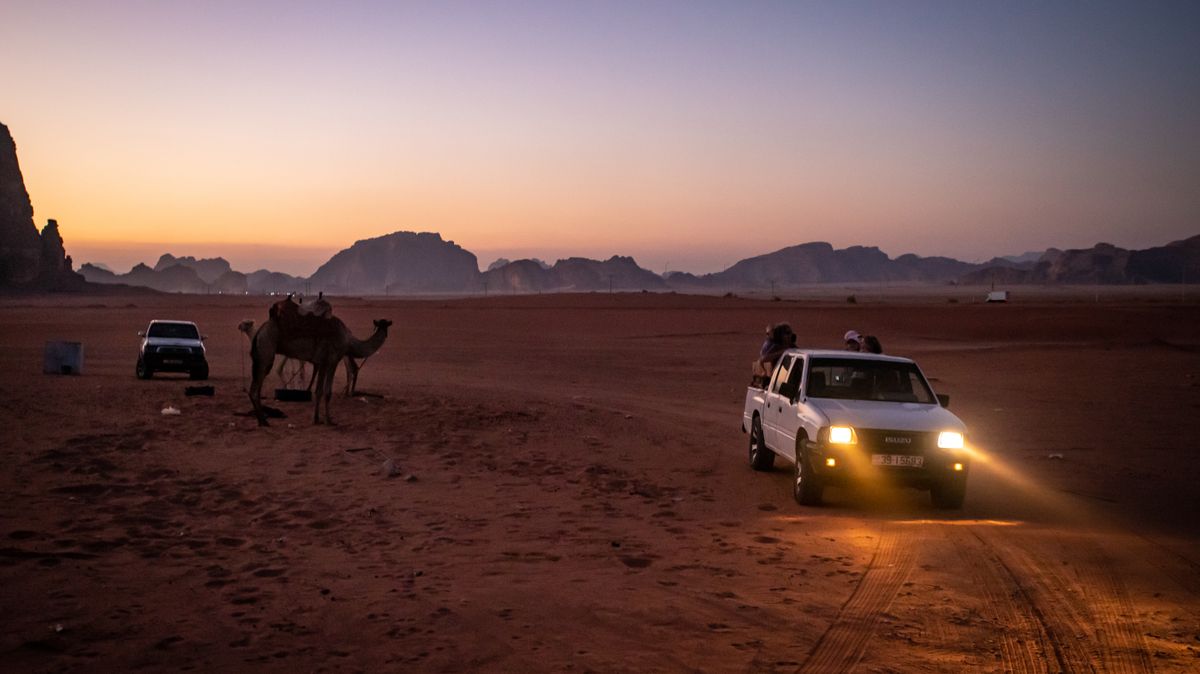
The circuit usually includes Lawrence’s Spring, a site associated with T. E. Lawrence and the Arab Revolt of 1916 to 1918; Khazali Canyon, a narrow sandstone gorge containing ancient Thamudic and Nabataean inscriptions and petroglyphs; the Seven Pillars of Wisdom, a prominent rock formation visible near the Visitor Centre; and the Red Sand Dunes, which are popular for short hikes, sandboarding and sunset views. Many tours also stop at Umm Fruth Rock Bridge and Burdah Rock Bridge, natural arches reached by walking routes or short climbs, though Burdah requires more scrambling and is not suitable for everyone.
Camel Rides and Longer Treks
A camel ride costs roughly 15 to 30 JOD for one to two hours, and most camps offer a short ride around sunset as an add-on to the jeep tour. Longer camel treks lasting a full day or multiple days are possible but need advance arrangement with a registered operator, because camels move slowly and require a different route plan than a 4×4. If you want a longer trek, book it before you arrive and confirm the route, the number of nights, the camping arrangements and what is included in the price.
Stargazing and Night Photography in Wadi Rum
Away from city lights, the desert sky over Wadi Rum is dark enough to show the Milky Way to the naked eye on clear, moonless nights, and the star density is extraordinary compared to urban or suburban skies. Most camps offer informal stargazing sessions after dinner, and some provide telescopes or guided constellation talks, though the quality varies by camp.
For night photography, bring a sturdy tripod, a fast wide-angle lens with an aperture of f/1.4 to f/2.8, and a camera that shoots RAW files. Start with manual mode, an aperture of f/2.8, a shutter speed of 15 to 20 seconds, and ISO 3200.
Switch to manual focus, magnify a bright star in live view, and focus until the star becomes the smallest possible point, because autofocus will not work in darkness. Turn off image stabilization when the camera is on a tripod, use a two-second timer or remote shutter release to avoid touching the camera during exposure, and shoot several frames with slightly different settings to account for variations in darkness between camps.
Must-See Landmarks in the Protected Area
Khazali Canyon
Khazali Canyon is a narrow sandstone gorge about 20 minutes by 4×4 from Rum Village. The walls contain ancient Thamudic and Nabataean inscriptions and petroglyphs, some of which date back more than two thousand years. The canyon is short, usually taking about 15 to 20 minutes to walk, but the inscriptions are fragile and visitors should not touch or climb on the walls. Flash flooding can close the canyon temporarily after heavy rain, so check with your driver if you are visiting between November and March.

Burdah Rock Bridge and Umm Fruth Rock Bridge
Burdah Rock Bridge is a natural arch high on a rock face, reached by a scrambling route that takes about 45 minutes to an hour and requires a reasonable level of fitness and a head for heights. Umm Fruth Rock Bridge is lower, more accessible and suitable for most visitors, with a short scramble from where the 4×4 stops. Both arches are popular photo spots, and most jeep tours visit at least Umm Fruth. If you want to climb Burdah, tell your driver in advance, because not all circuits include the time or the guide needed for the ascent.
Lawrence’s Spring
Lawrence’s Spring is a small water source on a rock face, associated with T. E. Lawrence and his account of the Arab Revolt. A short walking trail climbs to the spring, which takes about 10 to 15 minutes, and the view from the top looks out over the valley. The site is more about the historical association than the spring itself, which is often dry or reduced to a trickle depending on the season.
Red Sand Dunes
The Red Sand Dunes are a popular stop for sunset, sandboarding and short climbs, and the walk to the top takes about 10 minutes. The sand looks its reddest in the late afternoon, and many tours schedule this stop last so visitors can watch the sun set over the valley. Some camps provide sandboards, or you can rent one from a driver for a small fee.
Seven Pillars of Wisdom
The Seven Pillars of Wisdom is a prominent rock formation near the Visitor Centre, named after T. E. Lawrence’s book rather than any specific feature of the rocks themselves. The pillars are visible from the road and from many points inside the protected area, and most jeep tours pass them on the way in or out of the desert.

Wadi Rum Itineraries: One Night or Two
A practical itinerary for Wadi Rum is one night and two days: arrive before noon, take a jeep tour in the afternoon, watch sunset from the dunes or from camp, eat a zarb dinner, sleep under the stars, then see sunrise before departing mid-morning. This gives you enough time to visit the main landmarks, experience a night in the desert and return to Aqaba or continue to Petra without losing a full day to travel.
One Night and Two Days
Arrive at the Visitor Centre by 11am or noon, pay the entrance fee, meet your driver and transfer to camp. Drop your bag, then head out for a four to six hour jeep tour that visits Khazali Canyon, Lawrence’s Spring, Umm Fruth Rock Bridge, the Red Sand Dunes and one or two other stops depending on the circuit.
Return to camp around sunset, have tea and watch the light change over the valley. Dinner is usually served around 7pm or 8pm, often a zarb meal cooked underground with chicken, lamb, vegetables and rice. After dinner, sit by the campfire, listen to traditional music if the camp offers it, then go stargazing away from the firelight.

Wake before sunrise, which falls between about 5:30am in summer and 6:30am in winter, and walk to a nearby dune or rock to watch the sun come up. Breakfast is usually served around 7am, and most visitors leave camp by 9am or 10am to reach Aqaba, Petra or Amman with enough daylight left for the next leg of their itinerary.
Two Nights and Three Days
Two nights allow a slower pace, a longer trek or a full-day jeep excursion to less-visited valleys. Arrive on day one as above, take a shorter afternoon tour or a camel ride, then spend the evening at camp. On day two, take a full-day 4×4 tour that reaches more remote areas such as Burdah Rock Bridge and the valleys farther from Rum Village. Return to camp in the late afternoon, have a second zarb dinner, then spend another night stargazing. On day three, see sunrise, have breakfast and depart.
Two nights are worth it if you want time to hike, if you are interested in astrophotography and want a second chance at clear skies, or if you prefer not to rush the experience. The extra night usually costs about the same as the first, so the total for two nights with meals and tours runs roughly 70 to 250 JOD per person depending on the camp standard and the tours you choose.
Costs, Entrance Fee and the Jordan Pass
The entrance fee for international visitors to the Wadi Rum Protected Area is 5 JOD per person, paid at the Visitor Centre. Children under 12 enter free. The fee covers access to the 720 km² reserve, and if you are staying overnight you pay only once. Jordanian citizens and resident permit holders pay 1 JOD.
The Jordan Pass covers the 5 JOD entrance fee, so valid pass holders should not pay that fee separately at the Visitor Centre. Present your digital or printed Jordan Pass and keep it with you. The pass does not cover jeep tours, camel rides, camping, meals or any vehicle fee for bringing a private or rental 4×4.
What a Typical Visit Costs
Typical prices in 2026 are as follows. A shared or small-group 4×4 tour costs about 20 to 40 JOD per person for several hours. A private 4×4 runs approximately 50 to 100 JOD or more, depending on duration and group size. A camel ride costs roughly 15 to 30 JOD for one to two hours. Traditional and mid-range camps cost about 20 to 60 JOD per person per night, usually including dinner and breakfast, while luxury bubble domes start around 100 JOD per dome and often cost 150 JOD or more per night.
Meals outside an included camp package cost about 5 to 15 JOD for a simple meal. A one-way taxi from Aqaba costs roughly 25 to 40 JOD. Prices vary substantially by season, camp standard, group size and booking channel. Cash is useful because card acceptance is limited and reliable internet is not available at most camps.
Tipping Etiquette
Tipping is customary in Jordan but discretionary. Use Jordanian dinars, tip at the end of the service, and give money directly to individuals where possible. For a jeep tour driver or Bedouin guide, tip 5 to 10 JOD per person for a half-day or full-day tour, using the higher end for exceptional service.
For camp staff generally, tip 5 to 10 JOD per person per night, either into a clearly designated staff tip box or divided among staff. For the zarb dinner cook or kitchen staff, about 5 JOD is appropriate, preferably given directly to the cook or left for the kitchen team before departure. For a camel guide, tip 5 to 10 JOD per person for a short ride, adjusted for duration and service.
Carry small 1 and 5 JOD notes, because cash is the most practical method. Ask whether the camp has a shared tip box; if so, use it for housekeeping, serving and kitchen staff, and tip the jeep driver separately if they are not included. For a couple, a reasonable total is 10 to 20 JOD for the driver, plus 10 to 20 JOD for camp staff, and around 5 JOD for the zarb and kitchen team. Tipping is not compulsory: reduce or omit it if service was poor, unsafe or materially different from what was promised.
Rules, Etiquette and What to Pack
Book a registered camp or local operator before you arrive, and confirm the exact camp location, pickup point, tour duration, vehicle type, meals and cancellation terms. Do not enter the protected desert alone after dark, because navigation is difficult and mobile coverage is uneven. Camp operators normally arrange the required Bedouin driver and navigation. Stay on established tracks where possible, do not climb fragile archaeological surfaces, and do not remove stones, fossils or artifacts. Avoid touching or marking petroglyphs, because the oils from your hands damage the inscriptions.
What to Bring
Pack warm layers year-round, because desert nights can drop close to freezing even when days are hot. Bring a fleece or down jacket, long trousers, a hat and gloves if you are visiting between November and March. Closed shoes with grip are essential for walking on sand and rock, and sandals or flip-flops are useful around camp. Carry sunscreen with a high SPF, sunglasses, a wide-brimmed hat and at least two litres of water per person for the jeep tour. A headlamp with a red-light mode is helpful for moving around camp at night without ruining dark adaptation.
Bring a power bank, because electricity is limited and you may not be able to charge devices overnight. Download maps, booking details and any offline guides before you arrive, because mobile coverage is weak or absent inside the protected area. A small amount of cash is useful for tips, drinks and any add-ons not included in your camp package. If you have allergies or dietary requirements, tell the camp in advance, because vegetarian, vegan and gluten-free options are available at most camps but need to be requested.
Modest Clothing and Local Customs
Modest clothing is respectful in Rum Village and at camps. Cover your shoulders and knees, especially when interacting with Bedouin hosts or walking through Rum Village. Alcohol may not be available at traditional camps, and visitors should follow the camp’s local customs around smoking, noise and campfire etiquette. If you are unsure about a custom, ask your host or driver.
Combine Wadi Rum with Petra, Aqaba and Dana
Wadi Rum sits in the middle of Jordan’s southern tourism circuit, and most visitors combine it with at least one other destination. Petra is about 1.5 to 2 hours away by road and is Jordan’s most famous archaeological site, with the Nabataean city, the Treasury, the Monastery and dozens of rock-cut tombs. Allow at least one full day for Petra, and ideally two if you want to hike to the High Place of Sacrifice or the Monastery. Combining Petra with Wadi Rum is the country’s most common southern itinerary: one or two days at Petra, one or two nights in Wadi Rum, then continue to Aqaba or return north.
Aqaba and the Red Sea
Aqaba is Jordan’s Red Sea resort, about one hour from Wadi Rum by road. The city offers swimming, coral-reef snorkelling and diving, and it works well before or after a desert stay. If you are flying into King Hussein International Airport, you can spend a night in Aqaba, visit Wadi Rum the next day, then continue to Petra or return to Aqaba for a final night before your flight. The contrast between the desert and the sea makes the combination popular, and the logistics are straightforward because the three destinations form a rough triangle.
Dana Biosphere Reserve
Dana Biosphere Reserve is farther north, roughly three hours from Wadi Rum by road. The reserve offers hiking trails, cooler mountain scenery and a different ecosystem from the desert, with oak and juniper woodland at higher elevations and arid slopes dropping into the Wadi Araba valley. Dana is worth adding for travellers making a longer loop through Petra and central Jordan, but it requires an extra day and a private transfer or rental car, because public transport connections are limited.
Frequently Asked Questions
Is one night enough for Wadi Rum?
One night is enough to visit the main landmarks, experience a jeep tour, eat a zarb dinner and sleep under the stars. Most visitors spend one night and two days, arriving around noon, taking an afternoon jeep tour, staying overnight and leaving the next morning. Two nights allow a slower pace, a longer trek or a full-day excursion to less-visited valleys, and are worth it if you want time for astrophotography or prefer not to rush. If you only have one night, you will still see the key sights and get a genuine sense of the desert.
Does the Jordan Pass cover Wadi Rum entrance fees?
Yes, the Jordan Pass covers the 5 JOD Wadi Rum Protected Area entrance fee. Present your digital or printed pass at the Visitor Centre and keep it with you. The pass does not cover jeep tours, camel rides, camping, meals or any vehicle fee for bringing a private 4×4. If you do not have a Jordan Pass, the entrance fee for international visitors is 5 JOD per person, with children under 12 entering free.
What is a zarb dinner and can vegetarians eat it?
A zarb is a traditional Bedouin meal cooked in an underground oven. The cook digs a pit, lines it with hot coals, places pots of chicken, lamb, vegetables, rice and sometimes potatoes inside, covers the pit with sand and leaves it to cook slowly for several hours. The result is tender, smoky and served communally. Vegetarian and vegan zarb options are available at most camps if you request them in advance, usually with extra vegetables, lentils, rice and flatbread instead of meat. Tell your camp about dietary requirements when you book, because the zarb is prepared hours before dinner and cannot be changed on the night.
Can you self-drive in Wadi Rum or do you need a guide?
Ordinary cars stop at the Visitor Centre. Driving your own 4×4 inside the protected area needs a self-drive permit from the Visitor Centre on top of the entrance fee, and the rules and vehicle fees change, so ask there before you plan around it.
Most tracks are unmarked, mobile coverage is weak, and navigation is difficult without local knowledge, so a Bedouin driver is strongly recommended even if you have desert experience. The standard approach is to leave your car at the Visitor Centre and transfer to a Bedouin-operated 4×4 included in your camp package.
What is the best camera setting for Milky Way photography in Wadi Rum?
Start with manual mode, a wide-angle lens at f/2.8 or wider, a shutter speed of 15 to 20 seconds, ISO 3200, and a white balance of about 3200 to 4000 K. Shoot RAW files, switch to manual focus, magnify a bright star in live view and focus until the star becomes the smallest possible point.
Turn off image stabilization when the camera is on a tripod, use a two-second timer or remote release, and shoot several frames with slightly different settings. The Milky Way is visible to the naked eye on clear, moonless nights, so plan your visit around the new moon, allow your eyes 20 to 30 minutes to adapt to darkness, and ask your camp when the generator and outdoor lights go off.
How cold does Wadi Rum get at night?
Night temperatures in Wadi Rum can drop close to freezing between December and February, especially in exposed camps without heating. March through May and September through November bring cold but manageable nights, usually around 5 to 15°C, while June through August remain warm overnight, often above 20°C. Pack warm layers year-round, including a fleece or down jacket, long trousers, a hat and gloves if you are visiting in winter. Luxury bubble dome camps usually include heating or air conditioning, while traditional Bedouin camps rely on blankets and campfires. Confirm what your camp provides before you arrive, and bring extra layers if you feel the cold.
Planning more of Jordan? See our Petra guide, or browse all our Middle East guides.
Conclusion
Wadi Rum offers one of the most accessible desert experiences in the Middle East, combining dramatic landscapes, ancient inscriptions, Bedouin hospitality and some of the darkest night skies you will find anywhere. One night is enough to visit the main landmarks and sleep under the stars, while two nights allow a slower pace and more time for stargazing or longer treks.
Book a registered camp, confirm what is included in the price, pack warm layers and plenty of water, and check the current entrance fee and Jordan Pass treatment before you travel. Whether you choose a traditional Bedouin tent or a luxury bubble dome, the experience centres on the desert itself rather than the amenities, and the memory of sunrise over the red sand dunes will stay with you long after you leave.